Update 11/18/09: Thanks to Mainer 122’s comment below, I’ve just become aware of a blog post by Stanek containing what appears to be the original of the photo below. Looks like it might be authentic after all — or at least a Photoshopped version of an authentic photo of Stanek with Brian Jacques. In which case I owe Mr. Stanek an apology, at least about the photo. I’ll reserve judgment for now about the fake reviews and web postings. (And for the record, I’ve never questioned Mr. Stanek’s military service.)
I’ve recently become aware of a fantasy author named Robert Stanek. Many of you reading this have probably already heard of him, but I’m a little behind the curve.
Why might you have heard of Robert Stanek? Because he’s an unparalleled master of the fantasy genre? Well, I haven’t read any of Mr. Stanek’s work, so I’ll reserve judgment about his “Keeper Martin” series of novels. Go ahead, check ’em out for yourself. No, this sleazebucket author is known for his tireless deceptive acts of self-promotion. (Update 11/18/09: Okay, so I’ve had a change of heart about calling the guy a sleazebucket. Sue me.) He creates fan sites for his self-published work, writes hundreds of anonymous 5-star reviews for his books on Amazon, and invents online readers who compare his work favorably to that of J.R.R. Tolkien and J.K. Rowling.
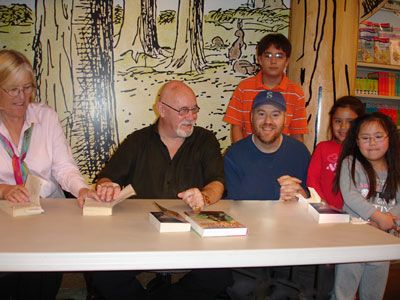 And if all that wasn’t bad enough, Stanek actually Photoshopped himself into a picture with renowned YA fantasy author Brian Jacques. Here it is, on the right. Take a careful look — hell, you don’t even have to take a careful look. Either Mr. Stanek is a contortionist, he’s a vampire from the waist down, or he forgot to Photoshop in a pair of legs underneath the table. Don’t take my word for it; the original is still up on the “#1 Robert Stanek fan site on the web.” Read more about this photo on CrapAuthors.com, including comments (supposedly) from Brian Jacques’ webmaster confirming it’s a fake. (Update 11/18/09: Looks like these links no longer exist.)
(Oh yes, in case you’re wondering, I did in fact post this photo without permission, despite a right-click warning from the site. Why would I do that? Well, I figure that it’s a fairly good bet that Stanek doesn’t have permission to post it either. If Stanek tries to sic a lawyer on me — or a fake lawyer, which he has done before — I could get some pretty good mileage out of posting all the correspondence. Besides, do you think anyone would actually threaten legal action over a doctored photo?)
In Stanek’s defense, I have to say that I understand the desperation that leads to these kinds of self-promotional measures. You walk into Megacorporate Bookstore hoping to find your book on the shelves… and you do! One copy! Meanwhile, there are piles and piles of Crappy Author X’s books in a fancy display at the front of the store, not necessarily because they’re better books, but because Megacorporate Publisher Y paid to put them on a fancy display at the front of the store.
And I say all this as a new author who’s been extremely fortunate to have gotten lots of attention from the SF world online, to have a large independent publisher that’s been gung-ho about the book since the beginning, and to have gotten nominated for a major SF award. I can only imagine how frustrating it must be to try to make it in this business without those things.
So lots of us smaller-fish authors will contemplate innovative (read: shady) promotional techniques to get noticed. We remind our friends again and again over e-mail that Amazon is still accepting reader reviews, should the urge strike them. We try to oh-so-innocuously slip a mention of the title of our books in the comments of more established writers’ blogs. We post trackback links to bigger fish in hopes that they’ll notice us. We have friends who will routinely turn our books around on bookstore shelves so the cover faces out instead of the spine.
I think most of us want to play by the rules. But what are the rules? Where’s the line drawn between enthusiastic self-promotion and unethical self-promotion? Sometimes it’s hard to tell, and every author seems to draw that line in a different place.
Here are the guidelines I try to follow myself in my own self-promotional efforts. I’d be curious to know where both readers and writers stand, so feel free to add your two cents in the comments.
 1. Tell no lies. There are plenty of moral gray areas about what constitutes a lie and what constitutes a simple exaggeration. But some things we can all agree on. Don’t claim you’ve won an award if you haven’t. Don’t claim you’ve been nominated for an award if you haven’t. Don’t state your book has been translated into Japanese, Urdu, and Welsh if it hasn’t. Don’t Photoshop yourself into a snapshot of Brian Jacques in an attempt to convince people that you’re his buddy.
2. Make no patently misleading statements. Avoid the temptation to try to mislead through statements that are technically not lies, but might as well be. If your book gets a 5-star rating somewhere, but it’s a rating system that goes up to 10, don’t proclaim in bold type that your book was given 5 stars. If your book gets a rave review by William Gibson, but it’s William Gibson the plumber from Mississippi, don’t try to pretend otherwise.
3. Avoid glaring sins of omission. This is a difficult guideline to follow, because it’s very subjective. Don’t use ellipses to claim that your book is “an absolutely terrific… thriller” when the actual review states that your book is “an absolutely terrific example of what not to do when writing a thriller.” Don’t try to sell to a group of Vietnam vets by claiming that your book has a Vietnam vet in it, while conveniently forgetting to mention that said character gets run over by a truck on page 4.
4. You have no obligation to point out the negative. The converse of #3 is that you have no obligation to go out of your way to point out the bad stuff. There’s an understood bias present in all promotional efforts, and there’s nothing wrong with that. You’re paying for your promotional effort, so you get to focus on the parts that put you in a good light. (On the other hand, if you want to post your bad reviews as a nice little publicity stunt or a way to highlight the good reviews, there’s nothing wrong with that either.)
5. Don’t impose an unnecessary burden. Mailing postcards to strangers is an acceptable way of getting the message out about your book (though whether it’s effective is another question altogether). There’s very little burden to the recipient; they can tell within seconds if they’re interested, and it’s easy enough to recycle those suckers. Ambushing people in bookstores to try to sell them your book is crossing the line, because it puts the burden of refusal on the customer.
6. No means no. All of us males who grew up in the ’80s and ’90s are aware of that dating guideline which states that “no means no.” If you’re on second base and she’s simply not interested in exploring the wonders of third base, you don’t overpower her and steal that sucker anyway. It’s immoral, it’s illegal, and it’s just plain wrong. Likewise, you shouldn’t badger potential customers into buying your book. Once your potential reader actively says no to you — take me off your mailing list, stop sending me crap in the mail, please stop serenading my dorm room in the middle of the night with ditties about your novel — then you stop.
7. Respect the competition. Savaging another author’s book solely for the purpose of drawing attention to your book is a no-no. (I’ll make an exception for Mr. Stanek.) That doesn’t mean you can’t respectfully disagree with another author’s point of view. It means that self-promotion is not a winner-take-all game, and your promotional efforts shouldn’t be done at the expense of another author. The reader can buy that other guy’s book promoting the single-bullet theory of the JFK assassination and your book claiming that it was really Dwight D. Eisenhower who pulled the trigger. (Oh, you think Ike wasn’t bitter about his VP losing the election in 1960 to some Harvard pretty boy? Puh-leaze.)
8. Keep your promotional activities above board. Don’t post glowing reviews of your books on Amazon under assumed names. Don’t start up your own fan websites. Don’t go through the phone book and call bookstores anonymously asking if they stock this amazing new book you’ve just heard about. In fact, any time a marketing activity involves the use of pseudonyms, that should raise a red flag. You should be able to list your marketing activities in a public forum with your head held high.
9. When in doubt, abide by general community standards. That means both abiding by the standards of the audience and the medium. Hacking into people’s cell phones to send them promotional messages about your book might be a clever gimmick at the Black Hat hackers’ convention; it probably won’t fly when you try to do the same thing outside the local mall.
10. Don’t pretend your book is all-important. Yes, you should take your promotional activities seriously. But understand that you can’t take it too seriously. You can feel justified running red lights, parking in handicapped spots, and driving on the shoulder if your wife is in the back seat going into labor. But if you’re running 10 minutes late to a reading? Um, no. Have some perspective. No reason to compromise your ethics just to get ahead in the literary world.