This book review was originally published in The Baltimore Evening Sun on May 9, 1994.
Douglas Adams’ fifteen minutes of fame as the author of The Hitchhiker’s Guide to the Galaxy series came to a close years ago. Why, then, should he suddenly add another installment to the humor/sci-fi story when he’s moved on to more ambitious projects?
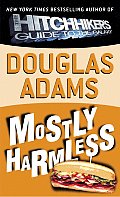 After reading Mostly Harmless, the series’ fifth book, it seems plausible that Adams simply needs the money. Although the book definitely has its moments, Adams has apparently grown bored and cynical about the entire concept. The result is a moderately funny but extremely unnecessary book with Elvis jokes you can see coming four gazillion light-years away.
For those not familiar with the Hitchhiker series, the premise is this: an extremely dry Englishman named Arthur Dent escapes from the Earth seconds before it is blown up to make way for a new Intergalactic Hyperspace Bypass. He ends up cavorting through time and space with a group of droll aliens, having adventures that brazenly defy any logical connection. The first three Hitchhiker books gathered a large cult following through their intense mockery of science fiction, philosophy, and British snobbery.
Mostly Harmless picks up the story from several different angles. Dent and his Hitchhiker pals Ford Prefect and Trillian have somehow found themselves in different parallel universes. In addition to this, they find that the ground rules of their lives have radically changed. Dent returns to Earth to find it inhabited by distinctly unhuman creatures who communicate by biting each other on the thigh. Prefect discovers that his employers are concocting a plot to sell their pan-galactic traveler’s handbook to everyone in several dimensions at once. And there are two Trillians wandering around, one of whom has had a daughter with Arthur Dent — without his knowledge, of course.
Adams works best when he tries to lightly poke holes in the concept of rationality. (The author did, after all, once work with the comedy troupe Monty Python.) One of the book’s cleverest bits comes in its opening scene, when a spaceship computer frantically tries to recall its mission after a passing meteor blows out its stored memories. The ship’s crew, without any recollection of what it was supposed to do, ends up latching on to the first passing mission it can find — astrology — and sticking to it with the utmost tenacity.
If this all seems very confusing, it must have been doubly so to the author. Adams’ response to the jumble he has created is the most curious of all. He wraps up all of the book’s sub-plots in one final scene that sourly places the Hitchhiker series into what seems to be a permanent retirement. It’s an unexpected shift of gears from Adams’ normal light comedy into utter misanthropy. Nothing seems to have come of all the chaos, and the impression the reader gets is that the puppetmaster has tossed his puppets out the window in annoyance.
Somewhere buried in the mess is a moral about learning how to feel at home in a chaotic universe. Unfortunately, Adams’ skills at conveying serious messages are nowhere near on a level with his skill at conjuring up non sequiturs, and the idea gets buried.
When an author is cynical about his own work, that should be a clear enough signal. Fans of the Hitchhiker’s series may still find things to chuckle at in Mostly Harmless, but few would want to invest in more than the paperback version. Others who are curious would be better suited borrowing the book from a friend.
I am in a group from my Science Fiction literature class and we have chosen to read the Hitchhiker’s series as our class project. There are 3 of us and we each have to read one book in the series. We are to compare the books and try to come up with a concept for the ‘next’ book in the series. One person is reading the first and another is reading the second. I assumed that I should read the last book in order to come up with the idea of what should come next. Since you have read the series, do you think this is the correct way to go about this? I have started the 5th book and it started off pretty strange and dull. Does it get better?
I should point out that it’s been, oh, 15 years or so since I’ve read Mostly Harmless. So I don’t think I’m going to be much help. If I remember correctly, it was not a particularly good book. I’d recommend you pick any one of the other four instead.
Someone else is reading Hitchhiker’s Guide to the Galaxy and another person is reading Restaurant Guide to the Galaxy. Which of the other 3 that you remember, would you recommend? I am looking for one that is fun and easy to read. We have 5 other novels to read as well as this project. Thanks for the help you are providing. Blogging is part of our project.
Of the three remaining Hitchhiker’s books, I’d say So Long and Thanks for All the Fish is the best.
Hello again. Okay, so I started reading So Long and Thanks for the Fish. I think it would be a better story if I had read the other 3 books first. I am lost and confused most of the time, but am finding it interesting. I have gone back and pulled up summaries of the other 3 books, so I am hoping that will help me understand a little more. The next part of our assignment is to come with an idea for “the next book in the series.” I know it has been a while since you read the books, but no one else has responded to my blogs. Do you have any incite as to some things you liked most about the series?
Thank you for your comments about this book. I listened to it on a recent drive between my home in Florida and my cabin in North Carolina and *literally* cried at the end — not because Adams had done a maestro job of plucking that particular string in me, but rather for just the opposite reason. It was as though he couldn’t figure out any other way to free himself from these characters, and, as you’ve put it so eloquently, in the very, very, very end, he seems to have had them learn nothing, he seems to have learned nothing from them, and the universe seems not to have been transformed one iota by their fleeting presence, in it. The cardinal rule of good fiction is that someone has to be ready to be transformed, and someone has to be transformed, both of which seemed to happen consistently in books I-IV. …Which made the fact that this isn’t just *a* book in the series, but the *last* book in the series, all the more painful to consider. I only hope that Adams didn’t hate himself as much as he seems to have hated what he hath wrought, in the last few years before he died. As an aspiring writer, that would make me very, very sad.