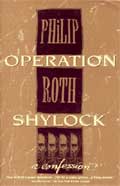
 This book review was originally published in the Baltimore Evening Sun on October 11, 1993.
Jerusalem is the land of contradictions. It’s the city of the hunted and oppressed that has inspired countless acts of violence and oppression. The city that several of the world’s largest and most conflicting religions claim as holy ground. The city that’s at the heart of the nation of paradox itself, Israel.
It’s also the city chosen as the setting of Philip Roth’s latest exercise in self-analysis, Operation Shylock. The novel asks why it is that American Jews — the so-called “normalized” Jews like Roth — can both revere and detest Israel at the same time. Is there a real truth about the so-called Holy Land and the people that support it, or is truth simply in the eye of the beholder?
Operation Shylock provides no easy answers. The book itself, like several of Roth’s novels, walks the tightrope between fact and fiction. It’s written in first-person confessional style and built on the foundation of factual events; yet a disclaimer at the book’s end insists that Shylock is pure invention. To confuse matters even more, Roth has claimed in public that he really did undergo a top-secret spy mission for the Israelis, as the book states.
Even if you take Roth’s claims for veracity as another one of his two-bit metaphysical pretensions, like I did, the novel does have an intriguing plot. The author, recovering from a mental breakdown caused by the dangerous painkiller Halcion, travels to Israel to interview colleague Aharon Appelfeld for The New York Times Review of Books. He discovers, however, that another Philip Roth has gotten there before him and has been preaching anti-Israeli doctrine in his name.
According to the other Roth, the Jews must abandon the concept of Zionism and return to their homelands in Europe before Israel disgraces the entire religion. Roth grows upset that his name is being used for political purposes — especially political purposes with which he doesn’t agree — and goes out to confront his doppleganger. He discovers that the “fake” Philip Roth is virtually indistinguishable from the “real” Philip Roth, and that people are buying the ruse. The imposter refuses to back down from his impersonation, claiming to be a martyr for the cause of Jewish Diasporism.
The views espoused by “Philip Roth” quickly come to the attention of both Israeli and Palestinian intelligence, and soon the author can no longer distinguish reality from subterfuge. As a high-profile Jewish figure, Roth begins to suspect that he is being ensnared by both Israelis and Palestinians into working for their causes. Innocent encounters begin to seem like carefully crafted plots designed to sway his opinion.
To top things off, this all occurs at a time when tensions couldn’t be greater between Arab and Jew. Israel is involved in the trial of John Demjanjuk, a Cleveland auto worker accused of being the notorious Nazi torturer Ivan the Terrible. The legitimacy of Jewish and Palestinian claims about Israel rests on whether Demjanjuk is really a monster finally being brought to justice or a poor immigrant being subjected to a sham trial.
For Roth, the final truth to the Israeli-Palestinian conflict is that there isn’t any. Israel is both a paradise for the Jews and a nightmare for the Palestinians; Demjanjuk is both a model American citizen and a Nazi butcher; and the Israeli intelligence agency the Mossad is both manipulative and deceitful as well as a noble institution worthy of working for. If there is any simpler truth, the author concludes, it cannot be deduced from the evidence that is now before us.
Philip Roth does discover one ultimate truth about himself and the Jewish people in Operation Shylock. It’s a statement made by the late Bernard Malamud: “If you ever forget you’re a Jew, a gentile will remind you.” In other words, Jews will always be Jews before they are anything else — especially in Israel.
Sounds like one hell of an intriguing book. You don’t censor comments? Wow! I thought only Pat Buchanan had that much character.
But I’m a little disapointed, with that moniker “Shylock”, I thought that this Jew was going to deal with Jewish nature, the Jewish trait of acquisitiveness. Nah, not to be.
From what I gather here, Mr Roth is just a brilliant Zionist propagandist. His purpose being to establish moral equivelance between the brutal taking of a peoples homeland, and the resistance struggle of the dispossessed people. Just more brilliant Zionist propaganda.
Whatever you might call Philip Roth — and there are many things you might legitimately call him — I don’t think you can call him a Zionist propagandist. You’re talking about the Jewish author that’s pissed off more Jews than just about any other. Of course, given that I wrote this review 16 years ago, my memory might be faulty.
And c’mon, Dawg — “The Jewish nature of acquisitiveness”? You really are trying to make me censor comments.
“But then to the entire world they are oblivious. For the entire world they have one word: goy! “I live here and I speak Hebrew and all I know and see are other Jews like me and isn’t that wonderful!” Oh, what an impoverished Jew this arrogant Israeli is! Yes, they are the authentic ones, the Yehoshuas and the Ozes, and tell me, I ask them, what are Saul Alinsky and David Riesman and Meyer Schapiro and Leonard Bernstein and Bella Abzug and Paul Goodman and Allen Ginsberg, and on and on and on and on? Who do they think they are, these provincial nobodies! Jailers! This is their great Jewish achievement—to make Jews into jailers and jet-bomber pilots!” ..philip roth
Phil–you said a mouthful!
Israel is a septic tank.